If you were blogging seriously back in 2024, something about how Google Search was working started to feel off.
At the time, I was working with an SEO strategist, Rahul, and we were hitting some pretty big goals.
Some of my blog posts were ranking at number one on Google, and others were sitting proudly on page one.
Rahul and I were over the moon.
My work on getting to the top of the pile was both collaborative and strategic.
Rahul and I would meet at the start of each month, decide on the topics in my lane that I was excited about, and then he would do the research to see what had ranking potential.
Then I would write with the same amount of soul, personal storytelling, and useful information as I do now.
But then our numbers started to drop, suddenly and unexpectedly.
Page views dipped. Search traffic softened.
All the little signs you expect to see when a Jenga tower starts to wobble began showing up in the data.
Rahul, being the expert strategist that he is, attributed it to SEO changing.
In fact, he predicted that the way we searched was changing, and that we needed to be prepared, keep learning, and ride out the storm.
So when Google made its big announcement this week about moving further into AI-powered search, I thought of Rahul, because he had seen the writing on the wall.
This was way bigger than a tech update.
It felt like Google was tearing up its old contract with us.
For years, small business owners were told the deal was simple enough.
Blog consistently. Choose your keywords. Create helpful content. Earn your place.
And eventually, people would find you.
That was the bargain. Of course SEO was never actually simple but the promise was clear.
Now Google is becoming the place that tries to answer before anyone clicks.
And people reacted. Actually, erupted might be the better word.
DuckDuckGo reported a jump in U.S. app installs after Google’s AI Search announcements, and visits to its AI-free search page also rose. On Threads, the commentary read like Google had personally staged a breakup with an old lover.
People talked about the death of blogging, the death of search traffic, and the death of small online businesses being found by the people who need them.
And I get it. The panic makes sense, but panic is not a strategy.
So I want to move beyond the first wave of hysteria and talk about what AI search for small business actually means now.
Because yes, search is changing, and yes, SEO is changing too, but being useful, specific, experienced, and clear still matters.
And I say that as someone who loves to write…
…who would keep writing even if a post brought in five readers instead of five thousand, but also as someone who has learned that you can use Google to be found, but you cannot build your whole business on an engine you don’t drive.
So What’s Changing in Google Search for Small Business Owners?
The fact that so many small biz owners use AI platforms like a search engine is because of Google conditioning, I swear.
But there is something else.
More than anything else, that usage emphasises the power of search.
The issue is not that people will stop searching.
The issue is that the click is no longer guaranteed.
Oh, the experience of the search itself will become more intuitive.
Your search box is no longer just a place where you type a few words and get a page of blue links.
Google’s AI-powered search experience means Search is becoming more conversational, interactive, predictive, and more willing to give people a full answer before they ever click through to a website.
According to Google’s announcement, we will be able to:
 Ask longer, more detailed questions
Add images
See Google summarise information from different sources
Pull it all together into one answer
Move through Search more like you are having a conversation than looking through a directory
There’s a ton of AI power behind Search now, which means the distance between the question and the answer is way shorter.
Before, someone searched, saw a list of links, clicked one, and landed on your website.
Now, in more and more searches, Google may try to answer the question right there on the results page.
That is the part small business owners need to pay attention to.
And it is the part where I see the silver lining.
Because Google is still in the business of getting people to the most useful, relevant answer as quickly as possible.
And that’s the part we have to remember as we move from SEO to AEO: Answer Engine Optimisation.
Don’t Forget the Humans Behind Google’s New AI Search
AEO is important. Wildly so in how we move forward as small business owners.
I’m going to get to that.
But there is something else in the equation that matters most when we talk about AI search for small business.
And it was there in the old search too.
Humans.
Not just us as the writers of our sites and blogs, but the people behind the screen consuming what we write.
The person searching is still human.
Let that sink in for a second.
They are still looking for help, clarity, proof, language, reassurance, and someone who understands the thing they are trying to solve.
They are still coming to the search box with a question, a worry, a half-formed idea, a problem they finally want to name, or a decision they are trying to make.
That part has not disappeared.
There is now a bigger demand for expertise that is easy to understand, easy to trust, and useful enough to be pulled into the answer.
What Google’s AI Search Can and Cannot Do
I’ll share a personal example form this blog post. For example, AI could have explained Google’s changes in SEO…
…but it could not have possibly known or told my story of watching rankings drop, working with Rahul, learning what changed, and seeing why small business owners still need clarity based on lived experience.
That is all me. Only I could have articulated that journey with that level of context.
As AI content has flooded the internet, listicle-based articles generic websites heavy with affiliate links have become the work du jour.
But human discernment has become more valuable too.
Google still has to serve useful answers, because that is what keeps people using Google.
Not sites or blog posts designed only to rank because of keywords and links bringing in commission.
Sorry. Not sorry.
This means small business owners should stop writing only for ranking and start writing for recognition from the community of humans they serve.
The goal is no longer only, “Can Google rank this?”
It is also, “Can a human read this and feel, ‘Oh my, she understands my problem’?”
Clarity has always been the hallmark of good SEO, and it will multiply with AEO too.

What Is AEO?
Definition time.
AEO stands for Answer Engine Optimisation.
We’re going to be hearing a ton about this going forward.
And no matter what, AEO = clarity.
Simple enough. Because it centres the website owner and/or the blogger on one thing only: Can your expertise be understood clearly enough to become part of the answer?
That is the shift.
SEO helped people find your work.
AEO asks whether your work is clear enough, specific enough, and trustworthy enough to be used as the answer.
So as you write, I need you to be aware of the same things I’m telling my students.
Make sure your human expertise is easy to understand.
Ensure your content answers the question people are actually asking. See how one of my pillars clearly states: What is AEO?
Make your examples specific and your point of view visible. AEO craves examples.
Also, your lived experience needs to do some of the heavy lifting.
Vague and Unclear Won’t Cut It.
The message from Google is clear. Vague content is going to have a harder time, and if you ignore AEO, your work may not travel the way it used to.
There is now a bigger demand for expertise shared by a human to a human, for the millions of people still searching.
And that is why I do not see AEO as the death of human writing.
But if Google’s AI search is going to pull together answers from across the internet, then the work that gets noticed cannot simply be content that exists.
It has to be content that explains, answers, and carries proof, context, specificity, and a point of view.
I love that for us. The small business owners who publish work that helps real people understand what we know, why it matters, and how it can help them make a better decision.
So no, AEO does not mean you stop writing like a human.
Generic content will struggle.
So will content that sounds like it was written by someone who has never actually done the thing they are posting about.Generic content will struggle.
Clear, useful, experience-rich content is now the tea.
The SEO Strategist vs The Storytelling Biz Owner
Rahul and I have a great relationship, but we disagreed on a fundamental point.
We both wanted the same thing, but we often knocked heads over how to get there.
As an SEO strategist, and a darn good one too, Rahul was always looking at traffic, clicks, and posts written to catch a keyword.
And yes, that is what I brought him onto the team for.
But as the writer, I can tell you that I did not love keyword stacking.
It killed the story.
And the story was super important to me.
I’ll always talk about our butting heads with care, because:
We both wanted the same thing: success.
Google rewarded Rahul’s SEO model for a long time.
But Google has changed the rules, and the story that builds authority, states the POV, shares the expertise, and remains decidedly human is the work with a fighting chance.
This is where AI search for small business becomes less about traffic and more about trust.
So if your whole business depends on someone clicking through to a page so you can make money from the visit, then yes, AI search is going to feel like a problem.
But small business owners have another path.
We do not have to build our businesses around traffic alone. We can build around the thing we actually help people do.
That might be a service, a product, a workshop, a planning system, a consultation, a method, an offer, or simply the lived judgment behind the answer.
And yes, AI can be trained on your process, your frameworks, your voice, and even your way of thinking.
That is part of the opportunity.
But it still does not replace the judgment behind your work, the trust you build with people, or the transformation someone gets when they work with you.
I’ll repeat this until I’m blue. Search is no longer a quantity game its a quality game
That is the part I’m telling my students and subscribers that they need to pay attention to.
In this new search landscape, content cannot just sit there hoping for traffic.
It has to point the reader somewhere: to trust, recognition, your offer, you!
You want someone to say, “I don’t just need an answer. I need her.”
>>> Loving this article on Google’s new search engine? Then please join my private community. 1x week, my small biz love letter aka weekly newsletter, goes to over 10,000 email subscribers who call it one of the best ways to get their work week started. Join In Comunity Here→ <<<<
AI Search for Small Business: Why Community Matters More Now
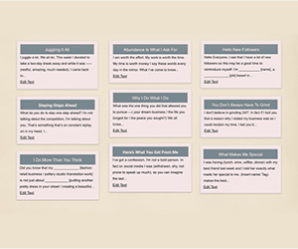
I want to show my first response to Google’s announcement about the new ways Search will work.
The five-part thread captured my first wave of emotion, and I stand by it.
One of the things I saw almost right away was how much more important community became.
This is one of the least talked-about parts of AI search for small business: community becomes part of your visibility strategy.
I have been relentless about community, both online and offline.
Community is the reason I decided to renovate my space and include a room for small gatherings, supper clubs, office hours, reading, and training.
When you can hold space for the people who value your work, believe in what you do, and care about what you share, Google becomes less important inside your own ecosystem.
Where To Build Community
So always think ownership first, and then think about the borrowed communities where you can still show up, learn, serve, and gather insight.
For me, that means your email list, your WhatsApp group, your private community, your workshop room, and your weekly newsletter.
Externally, think of things like your Facebook group.
At its most simple, community can also live in your comment section or around your real-life table where people gather.
When you look at that list, I feel confident you can see a place where you can start or build upon. Start simple and grow from there.
You’re a small business owner for a reason. You saw a need, you built something, you solve problems, you create transformation, and in 2026 and going forward, you can hardly do any of those things without community.
There, I said it.
The person who builds community is building a distribution bridge, but also memory.
So as you work on your site, your offers, your content, and your ecosystem, do not treat community like the thing you will get to later.
People remember your point of view, the way you explain things, the stories you tell, and the moment your words made their problem feel less foggy.
And when they are ready to buy, learn, join, ask, hire, or trust someone with the thing they are trying to solve, they are less likely to search from scratch.
They don’t search for you. They find you.
It’s that simple.
They come back to the person they remember.
That is the quiet power of community in this new search landscape.
And even if Google decides to pull a switcheroo on us tomorrow because the people decide this new search experience is not it, the person with community is not starting from zero.
And even if Google decides to pull a switcheroo on us tomorrow because the people decide this new search experience is not it, the person with community is not starting from zero.
I suppose this is why I’ll keep coming back to visibility. In Google’s new search landscape, visibility is not only about being seen by strangers online; it is about becoming findable, memorable, trusted, and connected to the people you actually serve.