


I was planning a holiday dinner a couple of years ago and working through my guest list when something hit me so hard it gave me goosebumps.
Table of Contents
ToggleTruthfully, it also made me feel sad.
Back in the day, my holiday get-togethers used to be legendary.
I’d have a live band, do the menus myself and work with a decorator friend to get the aesthetic right.
It was fun, community driven, and I loved hosting them.
I wanted to resurrect that feeling from ten years ago.
A celebration of Friendsgiving and the holidays wrapped into one.
But 2 years ago, by the time I sat down to write my guest list, something had shifted.
Or maybe it had been shifting for a long time and that was just the moment I finally saw it.
Flashback: A decade ago, my life had a different shape.
I had a large in-house team. I had friends I could call on a whim and ask, “what are you doing?”
And before long we’d be planning a beach trip or a conference, going out to dinner, talking for hours, making a whole weekend out of nothing and somehow turning it into everything.
But life kept moving, the way it always does.
What I Named And How I Planned
Besties move. The in-house team becomes remote.
The people I cared about were now tied to different countries , different rhythms, different lives.
The closeness and love were still there. What changed was the ease of it, the just-come-over part of it.
The part where community lived right there in the middle of my life without any of us needing to coordinate across time zones.
And I think, no, I know that planning that dinner was when I really knew I was missing something big.
Community.
I’ve written a lot about that longing before.
And maybe that is why, a few months later after this BIG aha moment, I started working with a design consultant, choosing fabric, looking at paint cards, selecting lights for a new kitchen and redoing a powder room in my home.
A Place to Plan, Build & Dream Together
I’m building something I’m calling the Commons.
A space for me to connect with community, break bread, mastermind ideas, sharpen our abilities to thrive, learn from each other.
The project’s design consultant, Dianne Hunte, is fascinated with the table we’re customizing and I get why after my initial push back.
It’s become a symbol of conversation and also particular kind of warm energy that fills up a room.
I’m building a space that can hold small groups of people. The whole thing made sense to me in a deep way.
The table above all else is the spot I keep returning to when I think about planning and thriving alongside other small business owners.
Planning a success path for a project like my new physical space or any of my online products, for that matter, never feels mechanical.
I’m not just ticking things off a to-do list
It’s always feels like I’m making room for a life I want; all the dreams that are floating in my head.
At least the dreams that start there, and end in something magnificently tangible.
All of it only comes to life because I’m a systems driven planner.
That’s what I want to talk about next with you.
A planning system that carries me through from quarter-to-quarter.
WARNING: the exercise comes with some very tough questions.
What is Quarterly Planning
Quarterly planning for small business owners has very little to do with writing a task list or setting up a Google calendar.
I mean that’s all well and good but that kind of busy must be anchored to something: alignment and systems.
You need a planning system around your goals and it needs to be structured so it can hold your dreams and allow you a measure of execution.
Structure will help link your goals to your vision, keep you on track so you’re not working from a place of hustle, defeat or even envy.
When it comes to the start of a new quarter, I’ve noticed something.
Each time a founder sees a 4- month period ending and looks deeply at what her last business quarter actually brought, in terms of momentum, she’s already ahead of the game.
I always tell my students that in systems driven planning, deep refection is crucial.
It allows you to see what deserves room in the new quarter. I wanted to bring this up here.
Because this kind of reflecting is the part most biz owners like to skip past.
Don’t!
If your aim is to have a business you love. One that supports your life and is anchored to your vision. then this of deep thinking is essential.
Quarterly Planning Starts Long Before The To-Do List
A to-do list can be a hot mess and you’ll never feel that it is because well, you’re busy.
There I said it.
Your to-do list works when it holds actions, singular ones. It doesn’t focus on entire outcomes or even true alignment. It will however always keep you busy.
Visioning belongs in your your plan. So does reflections, big goals and that execution strategy.
Even your budgets and accountability work flows should be placed there.
Structured quarterly planning sessions is not a cold exercise. And its not boring either.
I know there are plenty folks who think otherwise.
But there is a reason why I remain super excited about planning.
The Benefits Of Moving From Season To Season With A Plan
I equate planning, one that’s anchored to a vision and grounded by systems, to alignment.
It’s the main reason I don’t doom scroll or chase shiny pennies.
I also don’t allow a to-do list to anchor my quarter or even my year.
Sure, I’ll have a to do list, but before I do I must have a firm understanding of how the actions I take mirror the vision I’ve set for myself in each quarter.
A lot of it has to do with the infrastructure you set up for consistency and results.
We’ll get to that a bit later.
For now, I need you to remember the end game is alignment.
Planning ensures you have skin in the game and you remain on purpose.
It starts with seeing clearly enough to tell yourself the truth about what you want.
A Personal Example
For example, I’ll name the vision I have for my business or a need long before I’ve planned a success path.
Think of how I started the idea of the Commons by first naming “community” a missing piece in my business matrix
Having a vision for the physical space and what it could mean for me and others was an anchor.
I tell my students if they keep circling back to the thing that keeps tugging at their sleeves, they need to name it and plan for it as a goal.
Preferably it should be anchored to the big vision
And yes, logistics comes fast and furious. Again taking from my example. Once i knew I wnated to build the Commons ad why and how it would tie into also being a revenue stream
I began working right away on budgets timelines, hiring suppliers etc. Each piece of the puzzle had a road map and an accountability flow.
But its still the vision first, understanding the longing and what you need.
The system comes next.
Think of it as a structure that allows the development of consistency, habits.
A structured planning system will also give you a road map that’ll keep you focused.
This stops you from floating around in a cloud of ideas with no follow-through.
A real plan starts with a vision but it gets executed within a structured system.


What Q1 Can Reveal Before Q2 Planning
Right now we’re edging toward a new quarter. Consider it a reality check on your New Year’s ambition
We spend so much time consuming other people’s lives online.
Let’s take a time out.
Because if you’re scrolling, saving, pinning, gathering little pieces of other people’s lives and other people’s businesses and moving through yours like a shadow….
The Houston, we’ve got a problem. Listen carefully when I say this..
Staying in motion, keeping busy for busy sake, chasing ideas, and reacting to whatever the internet has decided matters this week, will keep you occupied for sure.
But this a false kind of busy.
And if it keeps compounding in this fashion, by December you’ll look up, and realise you’re no closer to the business you were meant to build .
That is why quarterly planning matters. It’s a temperature check that happens before one season ends and another one begins is crucial.
it’s time to ask if the goals you set when the clock struck midnight is even relevant anymore.
And it they are, are you on track, are you taking the right actions to get where you need your business to be?
Are you maintaining the timelines?
And what are the results?
As business owners, it’s easy for the urgent to keep dressing up as the important.
So before Q2 arrives, before you write another to-do list, before you convince yourself that the next quarter will somehow feel different while you are still moving in the same way.
I think there are a few things worth sitting with.
How To Build The Momentum For Q2
First step, consider what in Q1 helped to move the needle in your business?
Here’s another personal example.
The fact that I launched my first evergreen funnel in Q1 was huge.
I planned for this new income stream to become real and ready by March way back in December.
And it did.
I used the system inside my Business Reset Guide + Planner to complete 1%-5% of my goals each week.
Sometimes I executed big chunks of work all at once.
Other times I took small bites of the work
I gave myself time to achieve what I set out to do since the funnel comprised many different parts: an ads funnel, an email funnel, a sales funnel, landing and sales pages etc.
I was also working on a myriad of other projects, like the build out of my community space.
I was looking for momentum and I wrote the whole success path inside the Business Reset Guide and Planner using the guided sections.
Now, I’m not going to lie and say each week I executed perfectly.
But I will claim this proudly.
The planning system allowed me to develop a consistent patten and a weekly accountability flow that kept my momentum up.
End of Q1 Questions
So to move smoothy from Q1 to Q2, ask yourself..
What brought movement eg. more clients, more conversations, more aligned actions, more sales, clarity, traction?
Structured planning will allow you to review your routines, actions and timelines and wins/ losses by way to the road map.
I highly recommend getting it all out of your head and into your planner.
At first glance, it may feel like a lot. That’s normal.
But once everything is written down, you’ll feel more clarity than chaos.
When it’s time to plan a new quarter you’re no longer guessing or relying on memory.
You’re working from a road map you actually built and can follow.
What Happens When There is a Curveball
And of course life will throw curveballs.
Life will be lifing. Feel free to stop and start again without beating yourself up about it.
That’s the beauty of a structured plan.
It leaves room for you to slip up, and enough flexibility to reset.
However there is a but….
If you slipped up, and we all do, the difference between getting back up and giving up lies in your willingness to act fast especially if the failure is cheap.
By that I mean, not all delays on your success path are caused by big, significant things.
Sometimes you may not have hit your quarterly goals.
The reasons can be endless.
You got another project, you hurt your back. Maybe your energy level fell short.
In all those cases you need to reset as you carry some of the old objectives into the new quarter.
Can you do this quickly? Those dreams are not dead nor denied. They are delayed.
Again, when your goals are rooted in a system that contains a road map, you can “pre and post mortem” the risks and challenges associated with unknown events.
My advice, identify the challenges of Q1 so you don’t fail twice or three times at the same thing as you move into Q2.
Learn More About The Business Reset Guide + Planner. Click HERE or BELOW

Outside Your Comfort Zone
Ok, it gets a little bit choppy here. Nothing changes inside a comfort zone. You already know that.
So here are some uncomfortable questions you need to ask when reflecting on Q1.
These are not judgement questions. There is no system that I know of that has an ego.
Let’s move on with the questions
Think about these questions:
Pick Three Goals
Once you answer them your next step is to pick your three major goals for Q2.
That’s it.
Not five major or seven major goals, just three.
This allows you to sustain momentum.
There is something called the “Rule of Three”, and if you haven’t heard of it we need to go through it quickly.
“Rule of Three,” as an organising principle states the human brain instinctively processes information, recognises patterns, and manages cognitive load better in groups of three.
Once you realise that all of your major goals can be tied into a system, everything shifts.
You begin to see the big rocks.
If it’s not important to the vision and not urgent to getting you in alignment, you don’t need to do it; eliminate it before Q2 starts.
The Business Reset Guide +Planner Supports Quarterly Planning
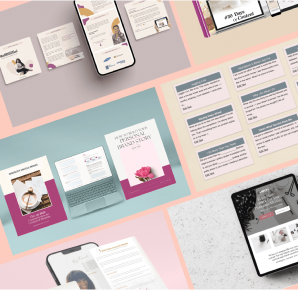
The Business Reset Guide +Planner is a six-part planning system.
Yes, it’s a gorgeous digital planner, which you can also print and use.
But it was never meant to be another pretty thing that gives you a temporary high, and ends up living under a pile of papers on your desk.
Real planning has layers. I’ll climb to the top of a hill and shout that out.
Each layer supports the next.
And you shouldn’t skip one just because you want to get to the next layer quickly or because you don’t want to face what each layer demands of you.
The Six Steps Include:
- Reflections
- Visioning + Goal Mapping
- Budgeting
- Quarterly Mapping
- Timelined Actioning
- Accountability Flows
Here’s how the Business Reset Guide + Planner was built, and this is absolutely critical to why systems driven planning works.
The system in the Business Reset Guide is grounded in psychology which I learned as a student at the University of the West Indies.
And it stuck with me because at the time, I wanted to develop a system that would help be with my overwhelm as a new student on campus.
I learned something that was game changing.
What The Brain Understands About Planning
I learned that the brain is designed to focus on only thing at a time.
Whatever it focuses on, you feel and whatever you feel, you move toward.
But… (there is always a but)
No one can directly control their focus.
This theory was in place way before Mark Zuckerberg’s took his first baby step and built us an attention economy. And the theory still holds up because a key you can direct your focus is through questions, because questions act like steering wheel of the mind.
Now you see why I kept my foot on the question framework throughout this entire article.
A good planning system needs it.
The moment you ask a question, your brain has to search for an answer.
It can’t help it. It’s automatic.
The Structure Under The Planning System.
So in each of the six sections of the Business Reset Guide + Planner, I guide you with grounded, strategy questions.
The questions centre on alignment, your vision, goals , budgets, your timelines etc.
The end goal is for you to have a working road map.
The system is hardwired for you think before you begin to move from one quarter to the next or from one year to next.
Remember, your brain goes to what it sees and is further fed by what actions you take.
Once you write it down you’ve built the road map.
You’ll now have a system that allows you to execute in alignment
You don’t focus on tasks, activities, or busy work.
Instead you focus on what moves the needle in a sustained way.
That’s how success paths are designed and the way you live your dreams you have for your business.
All right, that does it. I hope this was helpful.
Comment down below with any questions on how to plan effectively and build momentum in your business.
Learn More About The Business Reset Guide + Planner. Click HERE or BELOW